THFX: Being Human
Terms and Conditions

Term: Human being.
An individual member of the Human Race.
Term: the Human Race.

The Human Race, scientifically known as Homo sapiens, the Modern Human. As the dominant species and agency, the human race is in stewardship and charge of the planet Earth and all other species that inhabit it.
The Divine Spark of Curiosity
At some mysterious point along the evolutionary spiral, the gods—or perhaps the great mechanics of chance and necessity—bestowed upon the modern human three distinct gifts: upright posture, an advanced brain, and an insatiable, creative curiosity.
This triad reshaped the trajectory of life on Earth.
No longer trying to outrun the cheetah, humans began to outthink it. Biological, cognitive, and sociocultural adaptations conspired to establish human dominance over the natural world — not through brute strength, but through ingenuity.
The rise of bipedalism granted mobility, freeing the hands for toolmaking and the mind for dreaming. Guided by a growing neocortex and a complex network of neural pathways, Homo sapiens developed the unprecedented ability to solve intricate problems, build sophisticated societies, and communicate through symbolic language. Creativity fused with survival.
And when the world changed — as it always does — Nature favored not the strongest, but the most adaptive.
The curious. The imaginative. The ones who asked, “What if?”
Driven by the elegant mechanics of our nosiness, humanity launched itself into a wild experiment of invention. From sharpened flint to supercomputers, from cave paintings to artificial intelligence, we evolved by making — by shaping the world in the image of our questions.
And beneath it all, one question persisted:
What does it mean to be human?
That question is not a luxury of philosophy.
It is the engine of evolution itself.
The driving force behind the human race's evolution has been and remains the desire to understand what it means to be human.
The Human Race: Singular Beings in a Shared Story
The human race is not a monolith.
It is a mosaic — composed of individual humans, each one a singular constellation of genetics, upbringing, experience, beliefs, values, and temperament.
Every human being is born into a unique context, carrying a blueprint shaped by biology but continually redrawn by life itself. Identity is not static; it evolves — constantly sculpted by time, trial, memory, and meaning.
We are shaped, re-shaped, and often surprised by who we become.
To be human is to be in motion — not only through space and time, but through the inner terrains of selfhood.
Collectively, we form Homo sapiens, the only surviving species of the genus Homo — the last spark in a long line of vanished cousins.
But survival alone does not define us.
What sets us apart is our ability to wonder, to remember, to choose meaning, and to recognize that even in our individuality, we are bound to each other in a shared evolutionary story.
Term: Human Life
Proprietary and Transient
Human life is a paradox: we treat it like property, yet live it as if it’s infinite.
We say “my life,” “my time,” “my truth” — as if it were owned, secured, and insured.
And yet, every heartbeat is rented. Every breath is borrowed.
The lease terms are unclear. The expiration date is undisclosed.
To be human is to experience this contradiction daily:
To build as if forever, and vanish in an instant.
To claim authorship over something we never fully understood.
To curate identity like a museum exhibit, forgetting the walls are dissolving.
Proprietary — because we shape it, defend it, even monetize it.
Transient — because no matter how loud the ego speaks, time humbles us all.
And yet, in this fleeting window between two silences,
We create. We love. We question.
And maybe, just maybe, we learn to be present.
The Human Brain: An Organ of Infinity
If you’re reading this, you possess one of the most complex structures known in the universe: the modern human brain.
Homo sapiens sapiens — the “wise wise human” — emerged with a brain weighing between 1,300 and 1,400 grams, a size range that continues to define modern neurological potential. But raw size alone is only part of the story.
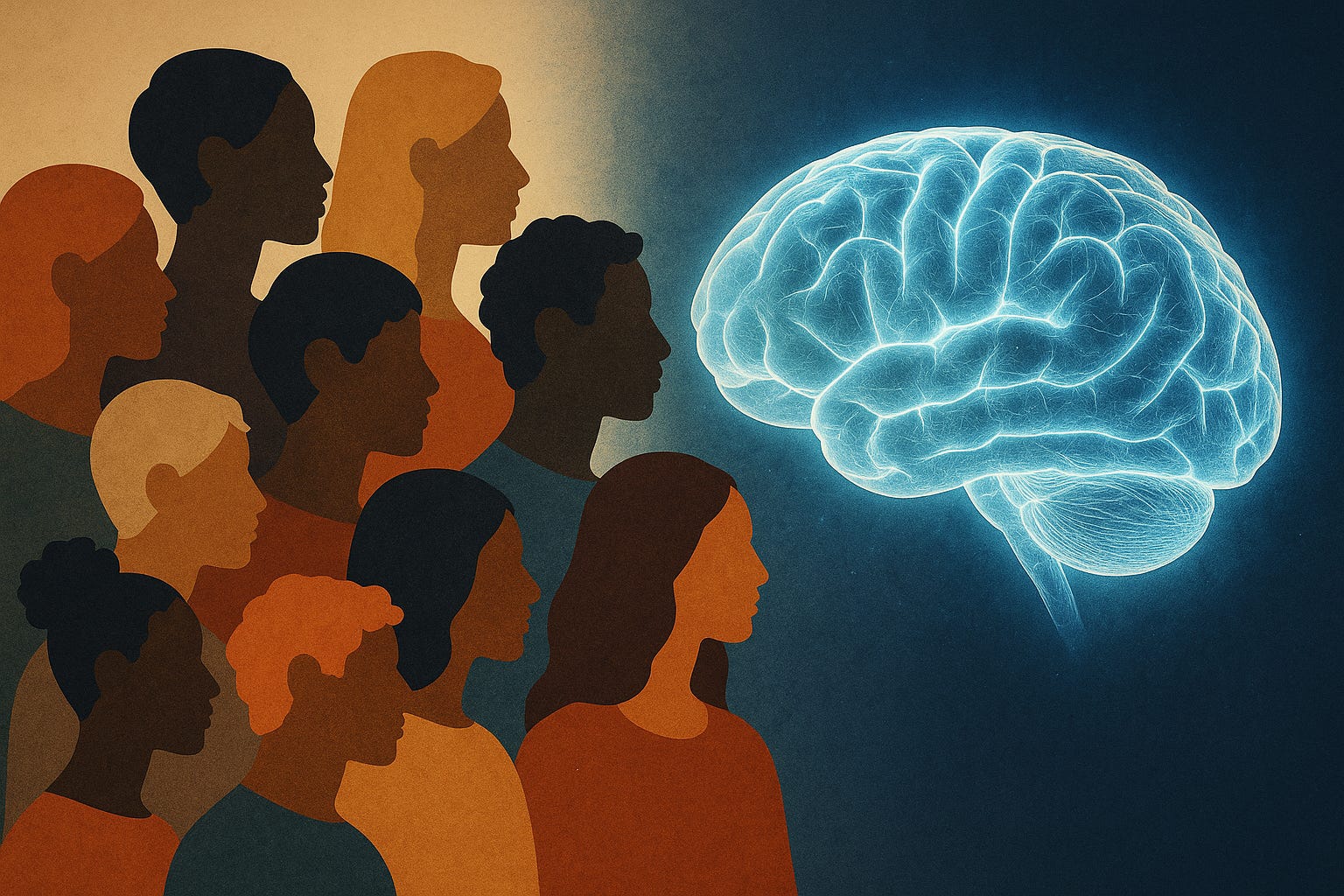
This evolutionary threshold marks more than biology — it heralds an explosion of cultural complexity, including the birth of language, symbolic expression, spiritual rituals, and the construction of tools far beyond basic survival.
What truly matters is not how much brain we have, but how it is organized.
The architecture of thought lies in the intricate folds of the neocortex, the orchestration of the limbic system, and the distributed intelligence of billions of synapses communicating at light speed.
It is this internal design — the hidden blueprint of cognition — that enables us to reflect, imagine, create, and dream. It allows us not only to survive our environments but to transform them.
The brain is not merely an organ. It is the place where memory meets imagination. Where instinct meets idea. Where time is bent into thought.
The modern human brain is our great inheritance — and our greatest responsibility.
Modern humans (Homo sapiens sapiens) emerge with brains within the modern range (1,300-1,400 grams).
This period witnesses an explosion of cultural complexity, including language, art, and advanced tools.
Brain size alone doesn't tell the whole story. Brain organization, specific neural structures, and their functionalities are equally crucial.
The Human Brain: A Universe Within
Imagine a universe within your skull, a vibrant, intricate network of billions of interconnected neurons, each a world of its own. This is the human brain, the orchestrator of your existence, the most complex organ in the known universe. Far beyond just a lump of tissue, it's the conductor of your life, controlling and coordinating everything you do, from the blink of an eye to the most profound philosophical contemplations.
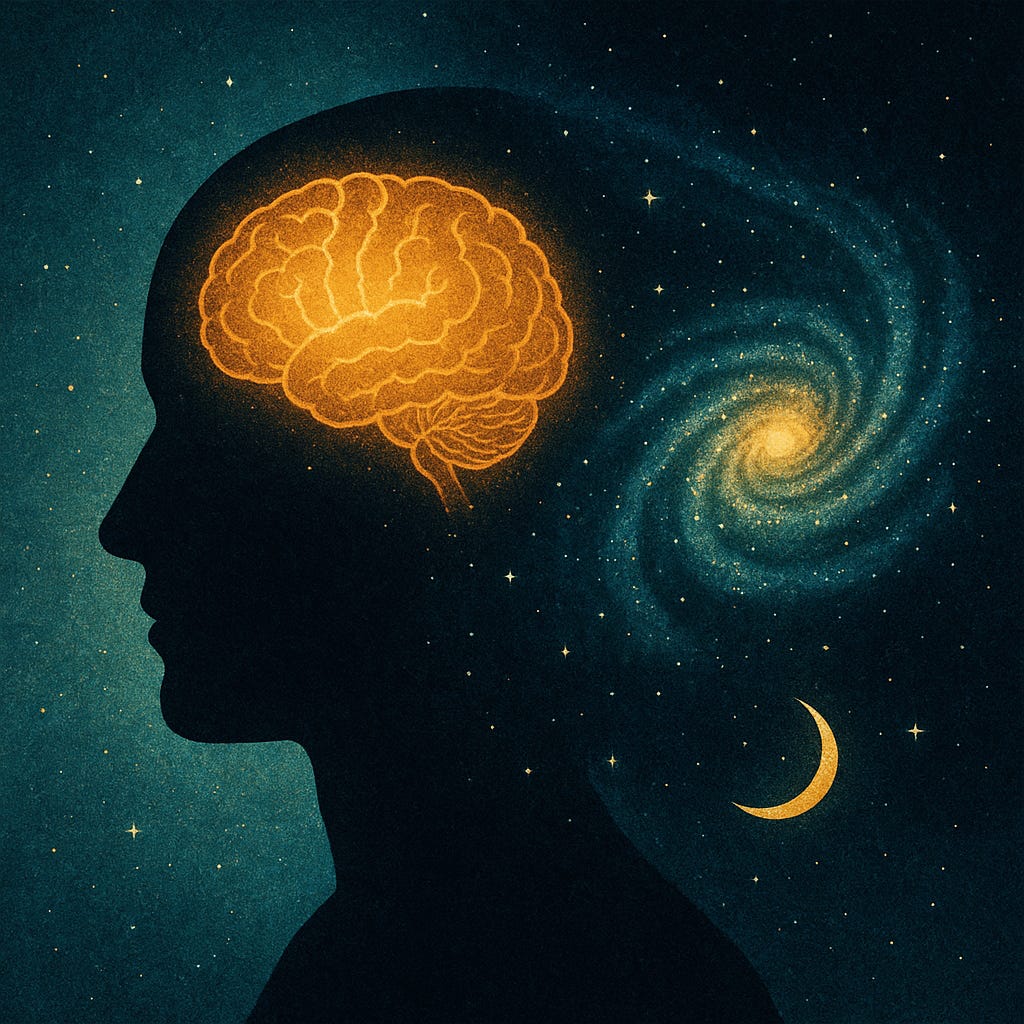
This is your brain — the orchestrator of existence, the seat of your consciousness, the most complex known structure in the observable universe.
Far from a mere lump of gray tissue, the human brain is an organic symphony, coordinating everything from the blink of an eye to the birth of an idea. It is the source of your memories, your decisions, your fears, your laughter, your sense of self. It writes the script of your life — moment by moment — and performs it simultaneously.
At the center of this cosmic machinery lies the cerebrum, the largest and most commanding region. Like a cathedral of thought, it houses the highest forms of human cognition: reasoning, language, imagination, and decision-making.
Its signature folds and wrinkles — a beautiful topography — increase surface area, maximizing neural real estate.
Divided into two hemispheres, it demonstrates asymmetrical brilliance:
The left hemisphere is our inner analyst — logical, verbal, detail-oriented.
The right hemisphere is our internal artist, creative, spatial, and emotionally attuned.
Together, they form a dual consciousness — often conflicting, yet always in dialogue with each other.
Tucked beneath this majestic dome lies the cerebellum — the silent calibrator. It is the fine-tuner of movement, granting grace to our gestures and balance to our every step. It does not speak in words, but in precision.
And anchoring it all is the brainstem — the oldest and most vital structure.
Here, life is regulated. The brainstem maintains the rhythm: it regulates our breathing, controls our heartbeat, monitors our sleep, and connects the brain to the body through an uninterrupted relay of signals.
Think of it as the spinal root of the soul — invisible, essential, and timeless.
In its totality, the human brain is not merely an organ.
It is a universe of thought, a living testament to evolution’s grandest experiment.
It reflects the outer cosmos in its complexity, and perhaps, in its silence, holds the keys to understanding it.
Cognition & Consciousness: The Unraveling of the Self
Within the vast labyrinth of neurons lies the secret engine of human experience — the birthplace of thought, awareness, and identity.
This is the realm of cognition and consciousness, where the self begins to take form and unravel.
The brain does more than store information — it weaves perception.
From the chaotic flood of sensory input, it composes a coherent narrative of the world: colors, shapes, sounds, smells, and textures are not experienced as data, but as meaning. The mind is the weaver; reality, its tapestry.
Attention serves as the conductor of this mental orchestra, directing the spotlight of awareness toward what matters in each moment, filtering out the noise to illuminate the signal. Without attention, there is no focus. Without focus, no clarity.
Memory, our internal archive, preserves the echo of what has been — storing experiences, knowledge, pain, joy, and identity itself. It not only allows us to learn but to recognize ourselves as continuous beings in time.
And then there is language — perhaps the most astonishing cognitive achievement of all.
More than just a tool for communication, language is a bridge between minds. It externalizes thought, translates emotion, and binds individual selves into collective understanding.
Deep within the brain, regions like Broca’s area and Wernicke’s area work silently and seamlessly.
They act as interpreters and translators, decoding the syntax of speech and generating the patterns of articulation that allow us to say:
“I feel.”
“I think.”
“I am.”
Through these processes — perception, attention, memory, language — the self emerges not as a fixed entity, but as an ongoing composition, constantly revised, constantly becoming.
Consciousness, then, is not a destination — it is the unfolding of the self in real time.
And so, within the soft, silent corridors of the brain,
the mystery of what it means to be human continues to unravel —
word by word, thought by thought, moment by moment.
The Living Mind: A Journey Through the Human Brain
“The brain is wider than the sky.”
— Emily Dickinson
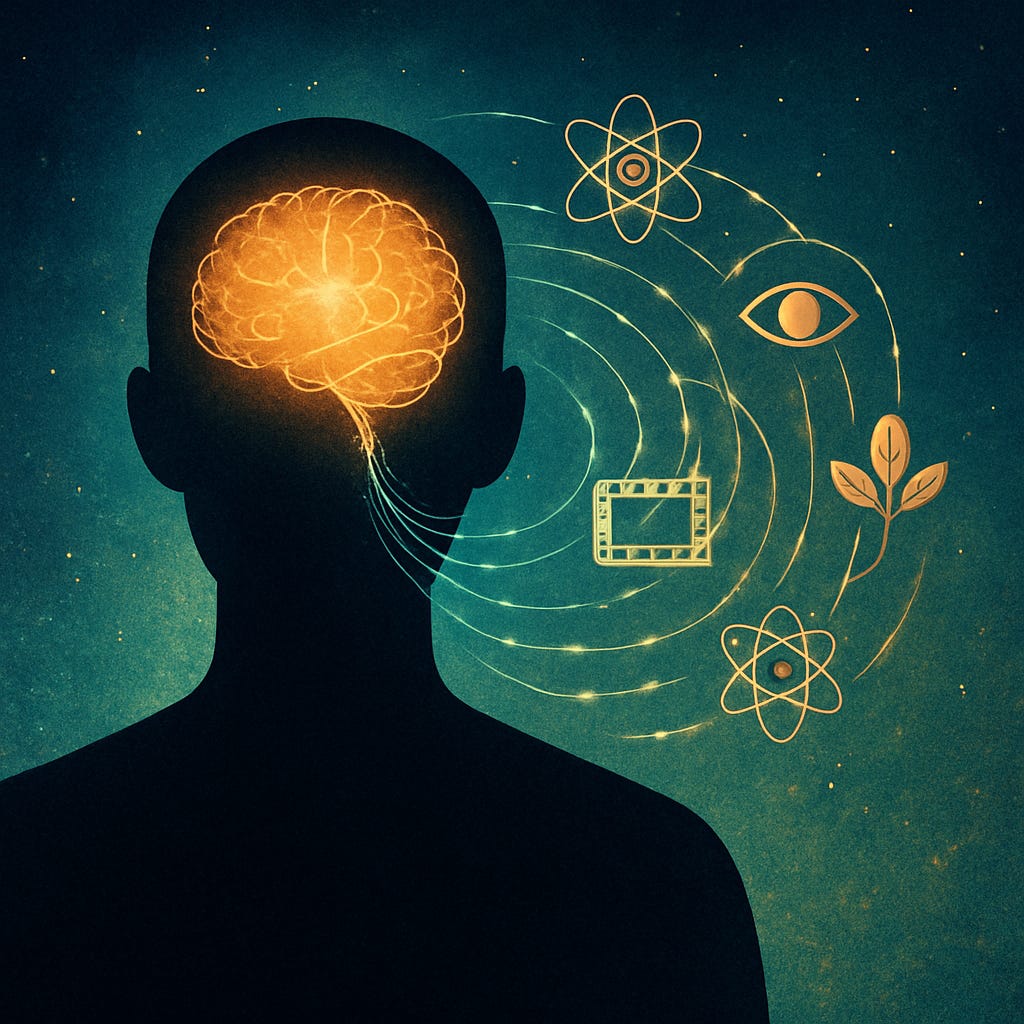
Beneath the surface of our skull lies an entire cosmos:
An organ of infinite complexity, pulsing with electricity and emotion, memory and mystery. The human brain — soft, silent, unseen — governs everything we are and everything we might become.
Let us step inside.
The Brain as Emotional Powerhouse
Emotion is not a distraction from intelligence — it is the color of experience.
Deep within the brain lies the limbic system — a network of ancient structures like the amygdala and hippocampus. Here, emotions such as fear, joy, anger, and love are not just felt; they are processed, shaped, and remembered.
The amygdala scans for danger, triggering our survival responses. The hippocampus encodes those emotional events into memory. Together, they do more than protect us — they drive us to connect, to learn, to remember.
Emotions are not noise. They are the signal.
Learning & Memory: A Dynamic Matrix
The brain is not static. It is alive, rewiring itself daily.
This remarkable ability is known as neuroplasticity — the brain’s capacity to adapt, grow, and transform in response to experience.
It’s how you learned your first language, and how you survived your first heartbreak.
Every memory rewrites the map. Every challenge strengthens the circuitry. Every choice becomes structure.
Different types of memory serve different functions:
Short-term memory holds fleeting information, such as a number, a name, or a moment.
Long-term memory archives our deeper narrative — the smell of home, the face of an old friend, the sound of a song that shaped us.
Memory is not storage. It is construction — forever in revision.
The Power of Communication
To be human is to speak — not just in words, but in gesture, expression, and presence.
The brain is a master communicator.
Regions like Broca’s area and Wernicke’s area enable the dance of language: forming thoughts, shaping them into words, and interpreting the words of others.
But communication doesn’t end there. Other neural networks decode nonverbal cues — the flicker of a brow, the tension in a shoulder, the silence between words.
Empathy begins where language ends — in the unspoken grammar of human connection.
Through communication, we share experience. Through shared experience, we build society.
The Quiet Symphony of Homeostasis
Beneath every conscious thought is a vast infrastructure of unconscious regulation.
The autonomic nervous system, governed by the brain, maintains homeostasis — the internal balance that sustains life.
While you read this, your brain is adjusting your heart rate, moderating your body temperature, and calibrating your blood pressure — all without asking your permission.
The brain is not just a thinker. It is a silent conductor, orchestrating the rhythms of survival.
Beyond Description: A Journey of Self-Discovery
The human brain is a paradox:
It is both subject and object, both explorer and map.
It is the foundation of your thoughts, emotions, memories, and self-awareness — and yet it cannot fully see itself.
It studies itself through science. It expresses itself through art.
And through each, it becomes more than tissue — it becomes self-aware.
Modern neuroscience continues to peel back the layers of understanding.
Yet the more we discover, the more mysterious it becomes.
Consciousness is not just a function — it may be the universe, looking inward.
A Note on Modern Evolution
Brain evolution has not stopped — it has slowed.
While the dramatic leaps of the past may be behind us, subtle shifts continue: in neural efficiency, in emotional intelligence, in how we process information in a digital age. Evolution is no longer just genetic; it is also cultural, cognitive, and technological.
We are not the same species we were 100,000 years ago.
And we are not yet the species we will become.