
The Human Factor: Stupidity. Part 1
Exploration of human stupidity and its impact on society and culture.


Stupidity is characterized by a deficiency in intelligence, reasoning, or good judgment. Stupidity is an inability to learn. Stupidity can be expressed in actions, behavior, or irrational, senseless, or counterproductive decisions.
Stupidity differs from a lack of knowledge; a person can be knowledgeable but still exhibit foolish or irrational behavior.
Stupidity isn't new.
Stupidity can be innate, assumed or reactive.
Stupidity can not be foreseen or fixed.
Stupidity is contagious.
Stupidity is an equal-opportunity menace, and does not discriminate against anything and anyone.
The Theory of Stupidity
For the sake of not re-inventing the bicycle let us turn to the wisdom of Carlo Cipolla, a Professor of Economics, and an erudite scholar, who left behind an enduring legacy and framework on the factor such as human stupidity.
Cipolla perceived stupidity as a deficiency in relational intelligence. Starting from the premise that our interactions can either yield mutual benefits or inflict harm upon ourselves and others, Cipolla labeled a stupid person as one who masterfully achieves both feats – causing harm to others and blissfully self-sabotaging.
"The stupid ones are more fearsome than the Mafia, the military-industrial complex, or the Communist International. They're an unorganized group, without a leader or norm, but in spite of that, they act in perfect harmony, as guided by an invisible hand."
In his satirical essay, "The Basic Laws of Human Stupidity," Carlo M. Cipolla delves into the intricacies of human folly, leaving behind a framework that transcends the mundane. The essay was published in 1988, first in Italian, under the title Allegro, ma non troppo ("Quickly, but not too quick").
"With the smile on his lips, as if he were doing the most natural thing in the world, the stupid will appear on the spur of the moment to spoil your plans, destroy your peace, complicate your life and work, make you lose money, time, good humor, productivity, and all this without malice, without remorse, and without reason. Stupidly".
“The Basic Laws of Human Stupidity” (1976) - once an underground classic, currently a vital piece of the puzzle to the biggest threat around: the human stupidity.
1. The First Basic Law of Human Stupidity:
"Always and inevitably, everyone underestimates the number of stupid individuals in circulation."
Spoiler alert – you're surrounded.
This law suggests that people tend to underestimate the prevalence of fools in society. It implies that there are more stupid people than we might initially think. A groundbreaking revelation that, without fail, everyone out there is hilariously bad at estimating how many stupid individuals are casually strolling through society.
2. The Second Basic Law of Human Stupidity:
"The probability that a certain person is stupid is independent of any other characteristic of that person."
This law states that stupidity does not depend on a person's intelligence, education, or other characteristics.
The likelihood of someone being stupid is as random as picking a card from a deck. A characteristic akin to hair or eye color, and therefore subject to equal distribution across all layers of society in a uniform manner.
Intelligence, education, regalia, and all other distinguishing features are irrelevant. Mind-numbing stupidity has no background.
Stupidity is the great equalizer, ensuring everyone gets a fair share of the absurdity pie.
3. The Third Basic Law of Human Stupidity/ The GOLDEN Law:
"A stupid person is a person who causes losses to another person or to a group of persons while himself deriving no gain and even possibly incurring losses."
This law highlights that foolish individuals often cause harm or losses to others without benefiting themselves. These are the unsung heroes of self-sabotage – the stupid heros. They manage to inflict losses on others or entire groups, all while reaping precisely zero benefits. It's the ultimate selfless act of foolishness, leaving everyone else to question the grandeur of their own decision-making abilities.
Fueled by irrationality, this perplexing behavior might leave you scratching your head. But fear not, for you've likely encountered that puzzling individual who, without any apparent gain, decided to play the role of an obstacle in your path, showering you with difficulties, frustrations, and the occasional dose of prejudice. The people who, according to Cipolla, "belong to the superstupid genus".
4. The Fourth Basic Law of Human Stupidity
"Not-stupid people always underestimate the damaging power of stupid individuals. In particular not-stupid people constantly forget that at all times and places and under any circumstances to deal and/or associate with stupid people always turns out to be a costly mistake.”
It's the Genius Underestimation Games, and the not-stupids are losing. This law suggests that intelligent or rational individuals often fail to recognize the extent of damage that foolish individuals can cause. The not-stupids are utterly clueless about the havoc stupid folks can wreak. Not-stupid individuals, with their superior intellect, are blissfully unaware of the sheer destructive potential of their stupid counterparts.
5. The Fifth Basic Law of Human Stupidity
"A stupid person is the most dangerous type of person."
This law emphasizes that foolish individuals can be more harmful than malicious or intelligent individuals. According to Cipolla, the most dangerous beings on the planet are not the cunning masterminds or the brilliant folks. Nope, it's the stupid ones! Brace yourselves for the revelation that these marvels pose a more significant threat than anyone else.
In essence, the peril posed by stupid individuals lies in the challenge they present to reasonable minds that struggle to fathom their irrational antics. An intelligent person can grasp the logic behind a bandit's actions. The bandit, in his twisted rationality, seeks to accumulate gains – a rather unpleasant form of rationality, but rationality nonetheless. This bandit dreams of a plus in his account, but alas, his intellect falls short of coming up with a win-win situation. He opts for the simplistic approach: producing his gain by imposing a loss on your account.While undeniably bad, this behavior adheres to a certain rational pattern. It's predictably irrational, if you will.
Unlike the perplexing unpredictability of stupidity, with a bandit, you can anticipate his moves, his unsavory tactics, and his unappealing aspirations. Armed with rationality, you can construct defenses against the foreseeable actions of a bandit, navigating the landscape of his machinations with a degree of predictability. In some cases you can even foresee the minus coming from a mile away.
Not so much in the case with the stupid. For in the world of stupidity, the logic, reason and predictability take a swift exit. Their know-how is firing unpredictability and chaos at everyone around them, including you, and their actions can have far-reaching consequences, causing significant damage to individuals or society as a whole.
Cipolla's chart: a graphical representation of human behavior based on the concept of rationality.
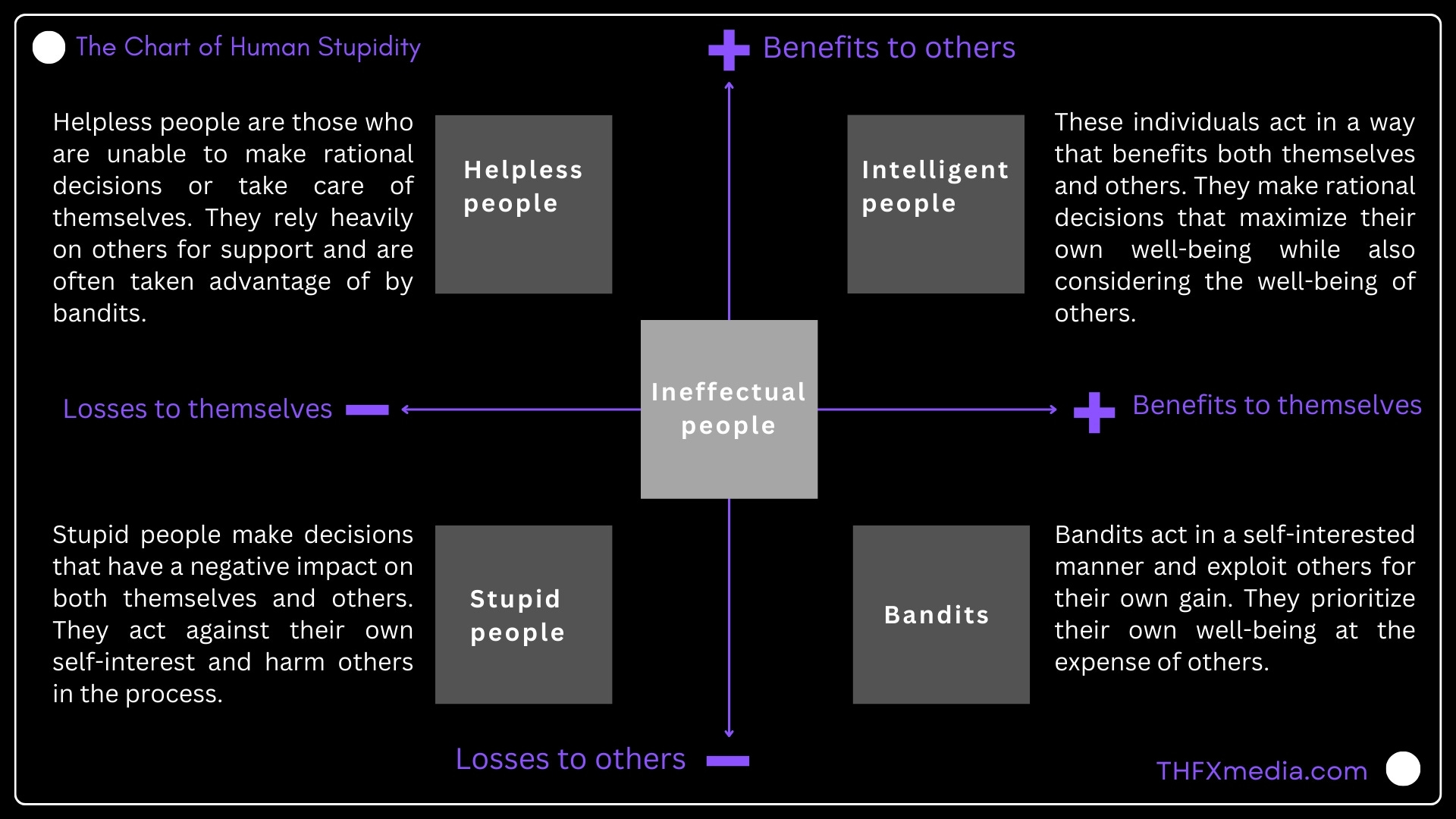
Cipolla's chart, also known as the "Chart of Human Stupidity," is a graphical representation of human behavior based on the concept of rationality.
Rationality is the capacity to reason, make decisions, and form beliefs based on logic and evidence. It is a fundamental aspect of human thinking and behavior. Rationality involves evaluating information, considering possible outcomes, weighing the pros and cons, and making choices that are consistent with one's goals and values.
Rationality can be seen as a goal-oriented process that aims to achieve the best possible outcomes given the available information and resources.
Rationality requires critical thinking, logical reasoning, and the ability to consider alternative perspectives. Rationality also involves being open to new information and adjusting one's beliefs and actions accordingly.
Human rationality is not perfect or unbiased. Our cognitive biases, emotions, and social influences can sometimes lead us to make irrational decisions or hold irrational beliefs. These biases can include confirmation bias (favoring information that confirms our preexisting beliefs) and availability heuristic (relying on easily accessible information rather than weighing all relevant evidence).
Nonetheless, the concept of rationality plays a crucial role in fields such as philosophy, economics, and decision theory. It is a tool for problem-solving, decision-making, and understanding human behavior. Rationality enables us to analyze complex situations, weigh evidence, and make informed choices, ultimately shaping our individual and collective actions.
Cipolla’s chart categorizes individuals into 5 different groups based on their actions and their impact on others.
Intelligent people: These individuals benefit both themselves and others. They make rational decisions that maximize their own well-being while also considering the well-being of others.
Bandits: Bandits act in a self-interested manner and exploit others for their own gain. They prioritize their own well-being at the expense of others.
Stupid people: Stupid people make decisions that have a negative impact on both themselves and others. They act against their own self-interest and harm others in the process.
Helpless people: Helpless people are those who are unable to make rational decisions or take care of themselves. They rely heavily on others for support and are often a target for bandits. In a constant pursuit for a break.
Ineffectual people: The fifth category in the center of the chart, represents individuals who have minimal impact on themselves or others, either positive or negative.
The Consequences of Stupid
Social Disruption
Stupid people can disrupt social harmony and stability. Their foolish behavior may lead to conflicts, misunderstandings, and breakdowns in relationships or social structures. This can create tension and division within communities. Stupid people, the maestros of chaos, master the art of disrupting social harmony with their foolproof method of conflicts, misunderstandings, and relationship breakdowns. Who needs stable communities when you can have tension and division?
Economic Losses
Stupid people can cause significant economic losses to themselves and others. The irrational decisions, actions, and genius moves of stupid people effortlessly lead them and everyone else into the abyss of economic doom. Irrational choices, poor investments, and a penchant for wasteful spending – it's the recipe for prosperity, obviously.
Exploitation
Stupid people can be easily manipulated and exploited by others. Their lack of critical thinking and poor judgment make them vulnerable to scams, fraud, and manipulation by individuals with malicious intentions. The ever-present, captivating vulnerability of stupid people, who, with their lack of critical thinking, become the perfect canvases for scams, fraud, and manipulation. It's like a magic show, where the disappearing act is your dignity and common sense.
Wasted Resources
Stupid people often use their expert efficiency to divert valuable resources, such as time, money, and energy, away from anything remotely productive.
Negative Influence
Behold the influencers of irrationality and poor judgment – stupid people. Stupid people can negatively influence others around them. Their foolish behavior and decisions may encourage or normalize similar behavior in others, perpetuating irrationality and poor judgment. Their choices are so groundbreaking that they inspire others to follow suit, creating a harmonious symphony of sheer silliness.
Underestimation of Damage
Intelligent or rational individuals may underestimate the damaging power of stupid people. Because foreseeing consequences is for the weak.
Intelligent or rational beings, beware! There's a tendency to underestimate the sheer destructive force of stupid people. This underestimation leads to a failure to address and mitigate the impending Foolish Apocalypse, allowing the chaos to persist and thrive.
The Corollary and Bottom Line
The stupid is more dangerous than a pillager.
Avoid stupid like or better than you would a bandit.

Real-time example captured by: Staci Herrick
Credits:
Full credits for the time, effort, and information, the work and the legwork, with all due respect, awe, appreciation, gratitude, and attributions to, quoted in italics, or influenced by, in no particular order:
Ancient Indian Epics, Albert Einstein, George Carlin, Armenian Epic and Folk Tales, The Bible, Ancient Egyptian Literature, Socrates, Fyodor Dostoevsky, Mike Judge, Aesop, Joseph Heller, Ancient Roman Satire, William Shakespeare, Richard Feynman, Lucinda Morel, Miguel de Cervantes, Stephen Hawking, Bertrand Russell, Justin Kruger, Stuart Sutherland, Plato, William James, Maurice Switzer, Lars Svendsen, Humphrey Bogart, Carlo M. Cipolla, Sophocles, Jonathan Swift, Samuel Beckett, the Unnamed, the Unknown, and the Many Others for the contribution into the study and understanding of the factor such as human stupidity.
What now?
"The first principle is that you must not fool yourself, and you are the easiest person to fool." - Richard Feynman
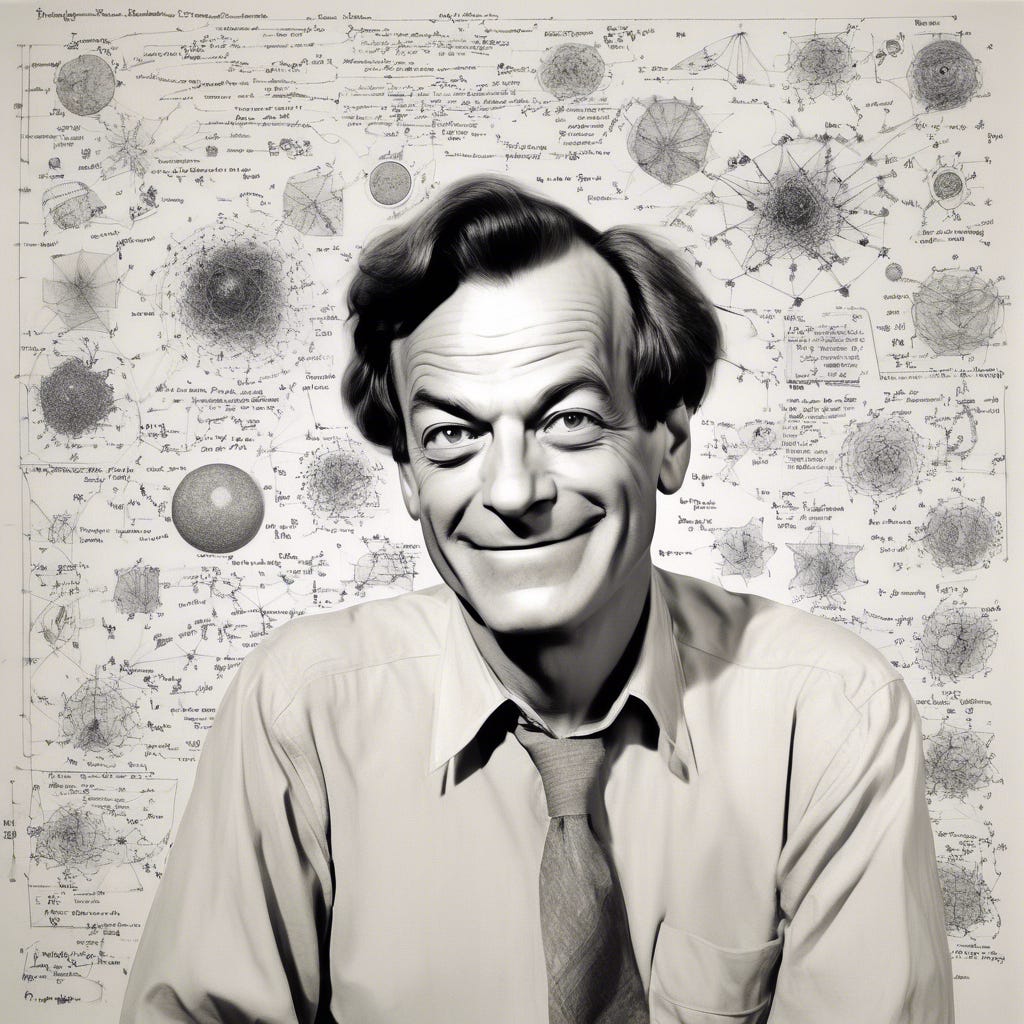
A brilliant American theoretical physicist who made significant contributions to our understanding of the universe.
Known for:
Quantum electrodynamics (QED) and the development of Feynman diagrams
The parton model, a key concept in quantum chromodynamics (QCD)
Contributions to the Manhattan Project and the investigation of the Space Shuttle Challenger disaster
Engaging and influential physics lectures and books
Stupidity is rumored to be the mother of Wisdom.
to be continued….